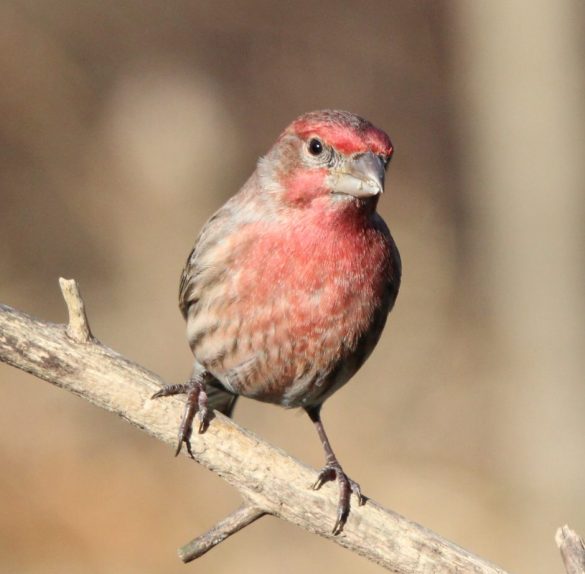
Now that the weather has turned cold your backyard feeders may be alive with birds. Some of these birds are quite easy to identify, like a Blue Jay or a male Northern Cardinal. Others may be more of a challenge, especially if they look similar to another species. Two fairly common winter birds that are tough to tell apart are the House Finch (Haemorhous mexicanus) and the closely related Purple Finch (Haemorhous purpureus). However, with these identification tips you will soon find yourself a finch expert!
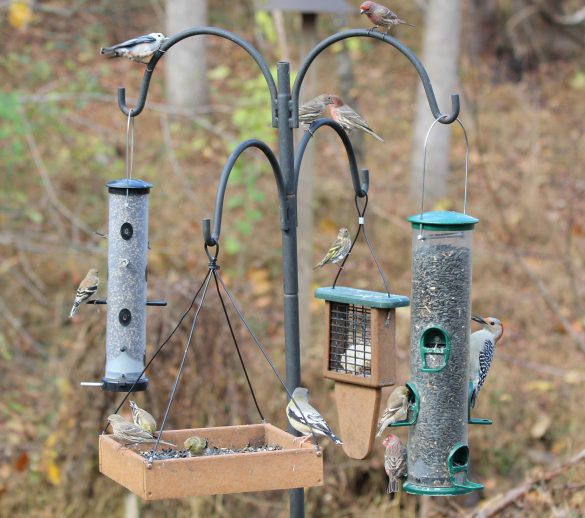
The Two Finch Species are closely related but have a different distribution
House Finches are native to the south-western United States. The males of this species can be very colorful, so small flocks of House Finches were transported to New York pet stores in the 1940s and sold as ‘Hollywood Finches’. Some of these birds either escaped from captivity or were released by pet store owners, after which they spread rapidly throughout the eastern United States. They were first recorded in Delaware in 1962 and are now found throughout the state year-round. As their name suggests, House Finches are usually found around people and are a common backyard bird.
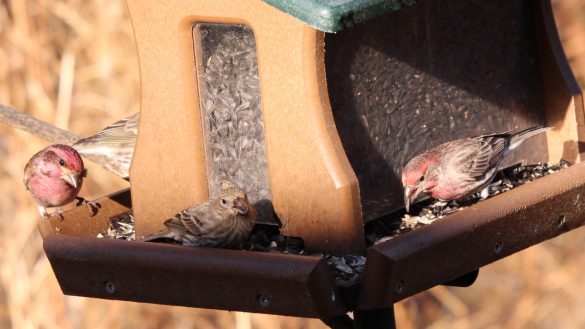
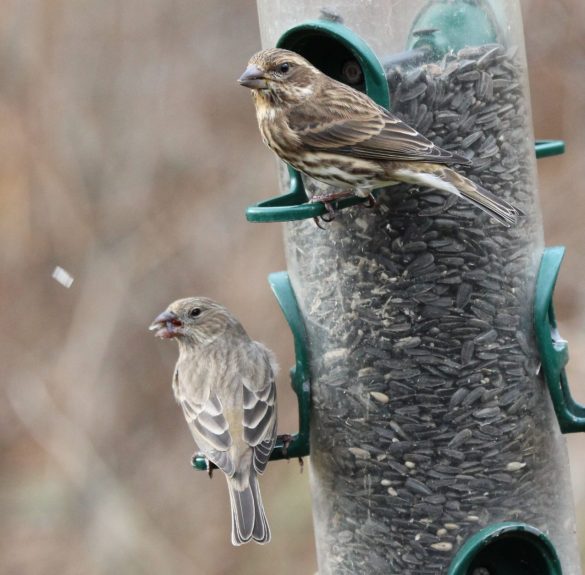
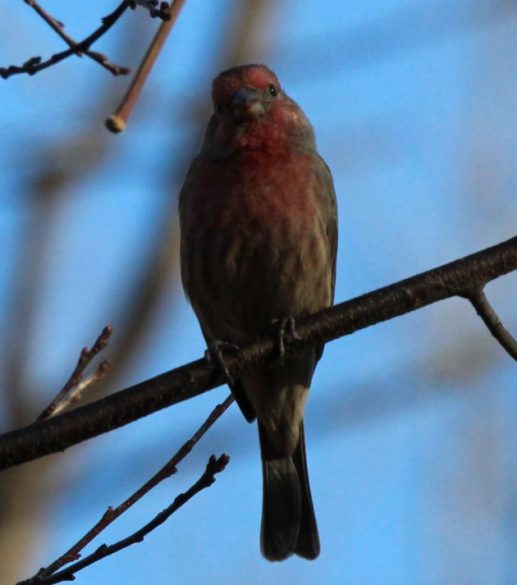
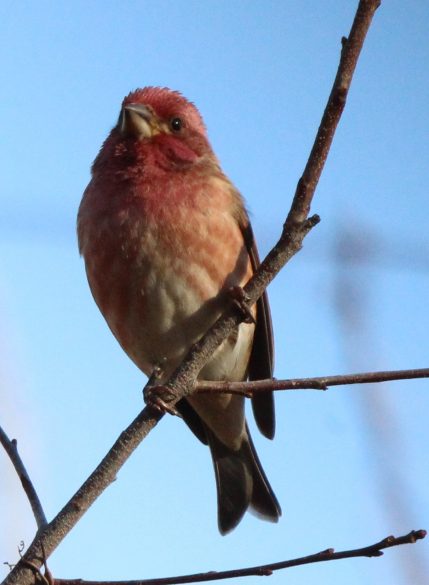
Purple Finches breed across most of Pennsylvania and north into Canada and are a classic ‘irruptive species’. This means they usually remain on their breeding grounds throughout the winter where they feed on a variety of conifer seeds. However, if the cone crop is poor, perhaps because the summer was hot and dry, the finches flood south in search of food. This winter (2025/26) appears to be an irruption year, as was predicted in the Winter Finch Forecast, with Purple Finches being spotted throughout Delaware and as far south as Georgia! Purple Finches are less tightly associated with people than House Finches and are often found in small flocks in woodlots and forests. However, they are also attracted to backyard bird feeders, especially when the weather is cold, and if they feed alongside House Finches the two species can be hard to tell apart. Are the birds below House Finches, Purple Finches, or a mix of both? Here are some tips to help you identify each one.
Overall Shape
A perched House Finch has a distinct, rounded head whereas a Purple Finch tends to have a flatter profile with a smooth transition between the back and head. Purple Finches are also more barrel-chested and have a front-heavy appearance which makes them look like they are leaning forward. If you see them up close, the House Finch has a heavier, more rounded beak, while that of the Purple Finch is a little more pointed.

Color and pattern
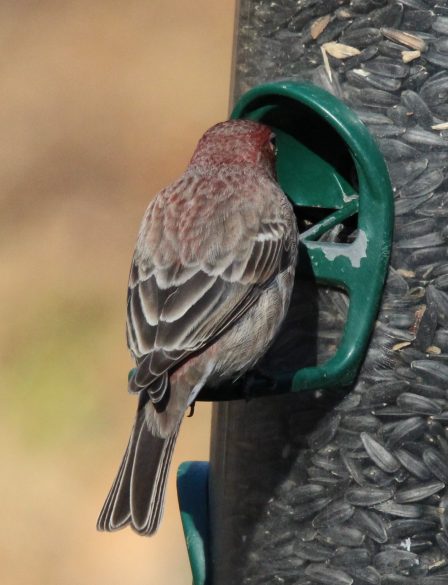
Male House Finches can be tricky to identify because they vary a lot in their color, which is related to the amount of carotenoid pigments they acquire through their diet. Some males have bright red feathers all over their head, breast, back and rump, while in other males these feathers are just dull orange or even plain brown.


Old male Purple Finches (those at least one year old) are easier to identify as they are always brightly colored across their head, breast and rump. The legendary birdwatcher and artist Roger Tory Peterson famously described them as ‘like a sparrow dipped in raspberry juice’! Old male Purple Finches are noticeably more pinkish than the brick-red color of the male House Finch, and their wings are also colorful, whereas House Finch wings are always dull brown regardless of how colorful the rest of their body is.
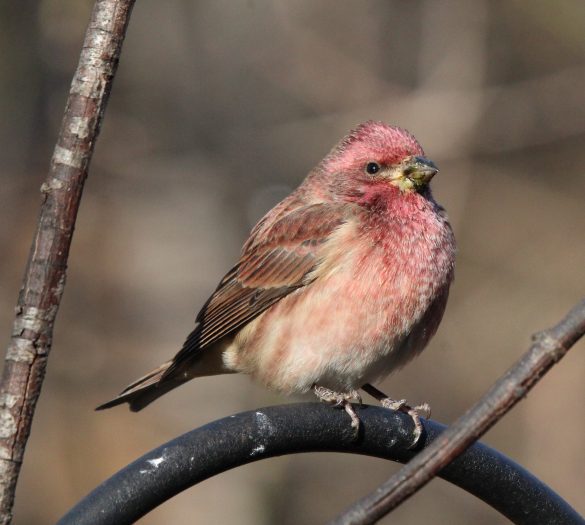
Also, the crown of male Purple Finches is all pink, whereas the coloration is more restricted to the sides of the head in male House Finches, so it looks like they have red ‘eyebrows’.
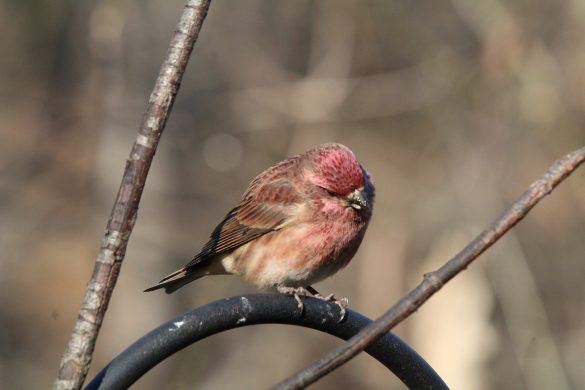
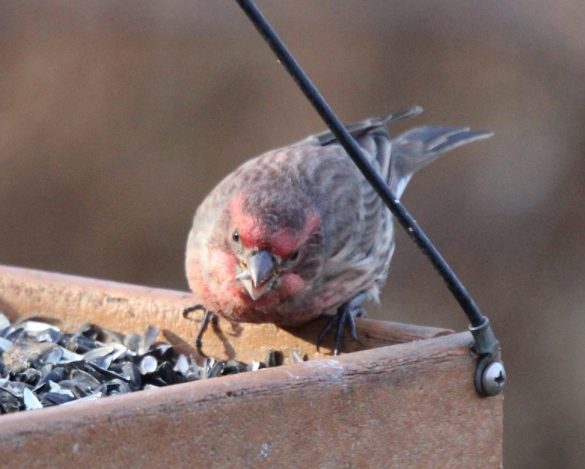
If you see the males from the front or below there are more features to help you clinch the identification. Male House Finches have bold streaking on their sides and belly, whereas the sides of male Purple Finches are either plain or just have small spots, and their belly is plain and bright white.


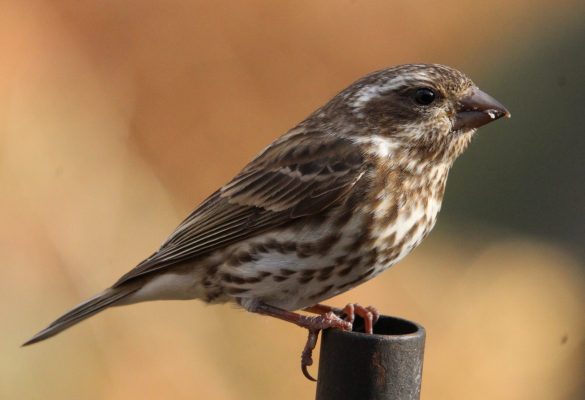
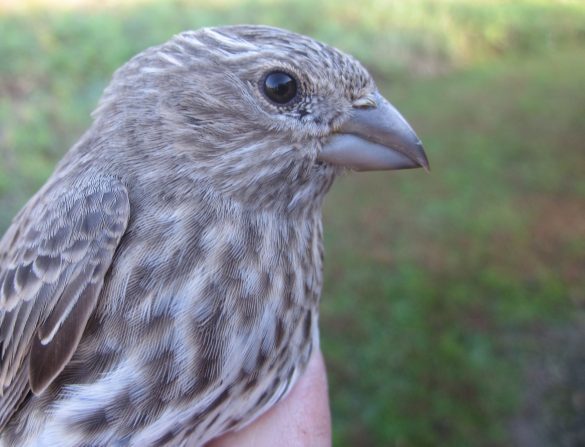
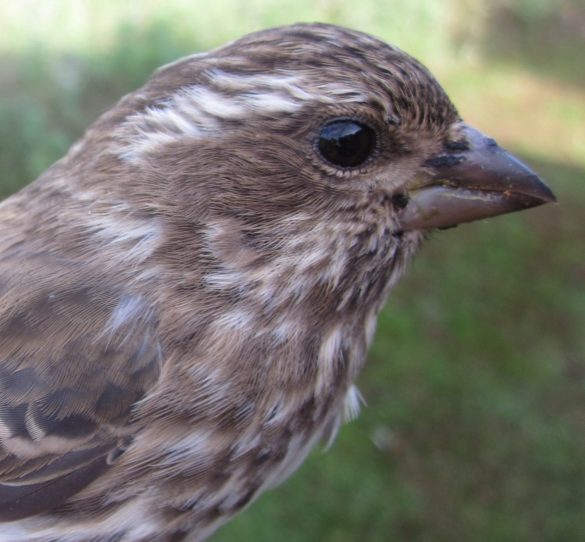
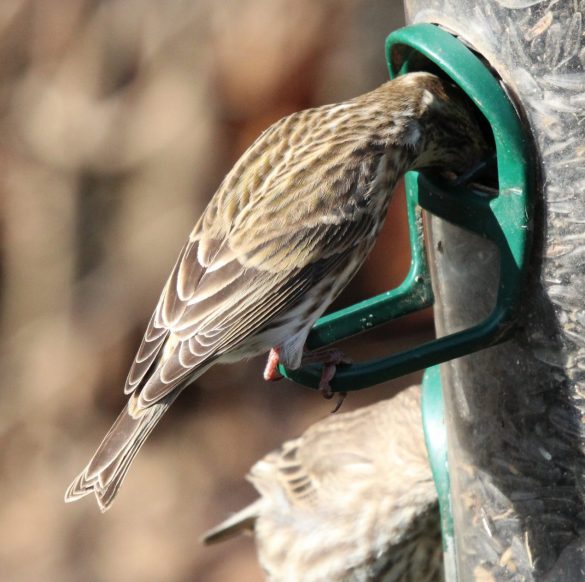
It is harder to distinguish female House Finches from female and young male Purple Finches (males hatched the previous summer) as they are both brown and streaky across their entire body. The key difference is their face pattern. Female House Finches have a plain brown face, whereas female and young male Purple Finches have a broad white stripe above their eye and a white ‘mustache’ which frame a dark brown cheek. The female House Finch also appears to have a smaller, ‘beady’ eye. The back of female and young male Purple Finches is darker and more patterned than that of House Finches, and their breast is more heavily streaked and chocolatey brown.
Tail Length and Shape
We collect body measurements from both species handled at our public bird banding station. We have found that Purple Finches are significantly heavier than House Finches (an average of 24.4g versus 21.0g) and have longer wings (83.5mm vs 79.4mm). However, Purple Finches have shorter tails than House Finches (58.9mm vs 63.2mm). These differences are especially useful for identifying finches perched at feeders. House Finch tails extend far beyond their wing tips whereas the wing tips of a Purple Finch reach almost halfway down their tail. House Finch tail feathers are always rounded whereas Purple Finch tail feathers tend to be pointed. Also, the Purple Finch has a more obvious ‘notch’ in their tail because the central feathers are proportionately shorter. The short, forked tail of the Purple Finch is a good field mark.
Enjoy those Finches!
You can get great views and photographs of both House Finches and Purple Finches at the bird blind at Ashland Nature Center in Hockessin, where the seed is generously provided by Wild Birds Unlimited in Hockessin. You can also attract them to your own yard with feeders of black oil sunflower seed (especially platform feeders). Have fun identifying these two attractive finches!